Article
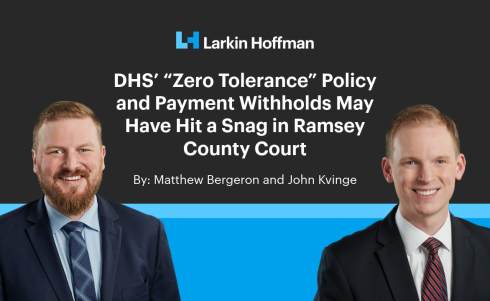
DHS’ “Zero Tolerance” Policy and Payment Withholds May Have Hit a Snag in Ramsey County Court
May 13, 2026
On May 7, 2026, a Ramsey County District Court judge issued an important order involving a temporary payment withhold imposed by the Minnesota Department of Human Services. The case that could have significant impacts for Medicaid providers and agency officials and create a new legal roadmap for providers facing a temporary payment withhold stemming from what DHS considers a “credible allegation of fraud.”
Under Minnesota law, DHS has the ability to impose a temporary payment withhold on providers where it determines there is a “credible allegation of fraud for which an investigation is pending.” As its name suggests, a temporary payment withhold is not intended to be permanent. As a result, some court decisions have held that a provider does not have a right to immediately challenge the basis of the withholding in court, because it is not yet a “final” decision. However, DHS has frequently left temporary payment withholds in place for years, with little to no action taken on the pending investigation. Without a path to obtain payment for services many providers are forced to close, even if the original allegation of fraud is ultimately found to be without support.
This recent case originated with Bright Community Services, LLC, a private company with multiple locations that provides home and community-based services for “high-need and vulnerable individuals” in Minnesota. In September 2025, DHS suspended all payments to Bright’s separate locations. Each of these locations has its own unique provider number. As the Court notes, the notice from DHS “applied to multiple provider entities of Bright with no allegations of any wrongdoing other than that the entities have ‘the same owner and tax identification number.’”
Bright subsequently challenged the temporary payment withhold, seeking a writ of mandamus on two fronts. First, Bright argued that DHS was required to lift the temporary payment withhold following the Minnesota Fraud Control Unit’s decision to decline the case. Second, Bright argued that DHS’ utilization of a “zero tolerance” policy with respect to withholding Medical Assistance payments violated state statute.
The Court found that Bright had met its initial burden to show DHS may not be exercising required discretion when making payment decisions. The Court laid out that Minnesota law obligates agencies to review all allegations and any evidence of fraud “carefully and acts judiciously on a case-by-case basis” before withholding payments. While, under Minnesota law, DHS has the right to turn off payments immediately, it must show that there is an ongoing review taking place to ensure the appropriateness of that action.
The Court issued a writ of mandamus which ordered DHS to:
either comply with their clear legal duty to: (1) review all allegations, facts, and evidence carefully and act judiciously on a case-by-case basis; (2) consider the nature, chronicity, or severity of the conduct and the effect of the conduct on the health and safety of persons served by the individual or entity; and (3) determine whether there is a ‘good-cause’ basis to continue the payments in accordance to federal regulations OR [appear before the Court] to show cause why [DHS] should not be compelled to take such action.
While the Court acknowledged that it cannot control how DHS exercises its discretion, the Court noted that “it appears that Defendants’ ‘zero tolerance’ policy may equate to the absence of discretion and common-sense with serious consequences for vulnerable people in Minnesota.” The Court went on to encourage DHS to “demonstrate that they are, in fact, exercising discretion and carefully evaluating the breadth of their payment withholding and the consequences of their actions on people who rely on these services.”
With the DHS Office of Inspector General recently testifying before the Senate Judiciary Committee noting the existence of more than 500 ongoing temporary payment withholds, the Bright case highlights longstanding questions about the capacity of DHS to meaningfully investigate providers alleged to have committed fraud in a timely manner. With limited to no other appeal rights, providers facing a temporary payment withhold have historically shut down operations following months or years of inactivity on allegedly “pending” investigations. While undoubtedly some providers subject to payment withholds have committed fraud, others are innocent of any wrongdoing and left without any avenue to prove their innocence, depriving vulnerable people of access to care without good cause. The Bright case may create a roadmap whereby, at a minimum, providers can challenge a temporary payment withhold to ensure that DHS has meaningfully evaluated their unique circumstances.
Larkin Hoffman’s team will continue to follow important developments around this ongoing story.