New Employment Laws
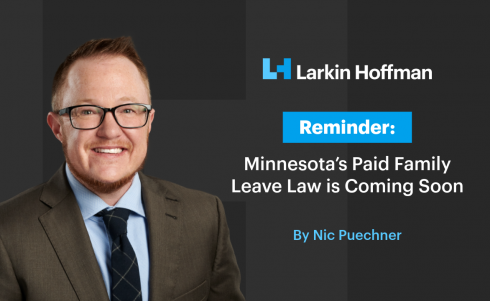
Reminder: Minnesota’s Paid Family Leave Law is Coming Soon
July 23, 2025
Nic S. Puechner
We first reported on Minnesota’s Paid Family Leave Law (PFL) in 2023, in which we described the basics of the law and the eventual effects on employers operating in the state. Although a number of updates and clarifications have been made since 2023, the effective date of January 1, 2026 has not changed. The following is a quick primer on the basics, including some changes since we first reported on the law.
A Reminder of the Basics
The law broadly covers nearly every employer, regardless of business size, revenue or number of employees. It covers nearly every employee, including full time, part time, temporary and most seasonal workers but contains limited exceptions for self-employed individuals, independent contractors and seasonal employees.
Benefits will be available to eligible employees who are unable to perform their work due to one of the following reasons:
“Family member” includes the employee’s spouse or domestic partner, child (including biological, adopted, step, or foster children, or a child raised by the employee even if not legally related), parent or legal guardian, sibling, grandchild, grandparent or spouse’s grandparent, son-in law or daughter-in-law or anyone close to the employee who depends on the employee like family, even if not related by blood.
To qualify, an employee must also have earned at least $3,700 (or 5.3% of the state’s average annual wage) during the last twelve months, submit a completed certification form confirming the condition or need for time off and have PFL leave available.
Employees can take up to twelve weeks of paid family leave or twelve weeks of medical leave in a single benefit year. Leave can be taken in multiple blocks for added flexibility. Employees who need both family and medical leave during a benefit year are eligible to take a combined twenty weeks of leave.
Paid leave payments are made by the state directly to the employee and is funded through premiums that are split between employers and employees.
Employees in their current role for at least ninety days who take PFL are entitled to return to the same or an equivalent position when they return to work, and employer benefits are maintained during an employee’s leave. Employers are prohibited from discriminating or retaliating against employees for taking PFL.
Updates You Might Have Missed
Thelaw allows self-employed individuals to contribute to the PFL fund, making them eligible for the benefits as well.
The premium rates have been increased to 0.88 percent. The statute permits the rate to be adjusted annually. Employees can receive up to 90% of their weekly wagesduringtheir leave, with a cap on the maximum payout. The maximum benefit amount has been increased to $1,372.00 per week.
What Should You Be Doing Now?
Considering that employees will be eligible to take PFL beginning on January 1, 2026, now is the perfect time to ensure that all stakeholders understand what is required to comply with the law. Employers with questions about the PFL law should contact Nic Puechner at (952) 896-3297 or npuechner@larkinhoffman.com.