New Employment Laws
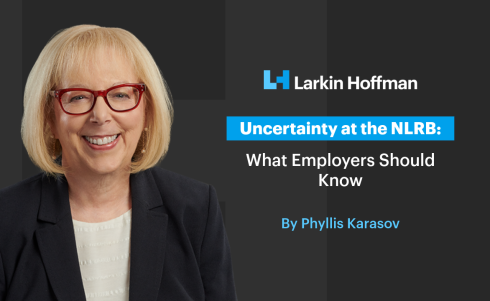
Uncertainty at the NLRB: What Employers Should Know
October 6, 2026
Phyllis Karasov
New Employment Laws
For most of its history, changes in the administration did not affect decisions made by the National Labor Relations Board (NLRB). In recent years, however, this has changed. We have seen how NLRB decisions change depending on the Board’s party majority.
The NLRB operated with only 3 of its required 5 members from January until August of 2026, when a fourth member was confirmed, giving Republicans a three to one majority, with the fifth member still to be appointed. We are already seeing the impact of this imbalance.
The NLRB’s General Counsel (“GC”) is the agency’s prosecuting authority. The GC supervises the investigation of unfair labor practice charges, and decides whether to prosecute a party. The GC also sets the legal agenda of the NLRB by deciding what the strategies and priorities will be.
During the Biden administration, GC Jennifer Abruzzo focused on making changes to NLRB policies and unfair labor practice decisions, which modified or overturned existing law. For example, GC Abruzzo oversaw NLRB decisions that expanded the definition of protected concerted activity and changed the union election process. She also pursued cases in which the Board found that a number of employee handbook policies and employer rules were illegal.
In January 2026, President Donald Trump appointed Crystal S. Carey as GC of the NLRB. Her initial focus was to reduce the significant NLRB case backlog, to encourage settlement rather than litigation, and to challenge the expanded remedies GC Abruzzo promoted.
On August 26, 2026, GC Carey issued GC Memorandum 26-04, in which she discussed her priorities and identified cases where she would like the NLRB to revisit precedents. For example,
In addition to these efforts to overturn or modify previous decisions, the NLRB’s structure continues to be challenged. Various federal courts have concluded that the protections for Board members and administrative law judges violate Article II of the Constitution. Many employers are using these challenges to dispute ongoing unfair labor practice cases. Further litigation on these issues is expected in federal courts.
Another challenge relates to a 2024 case in which the U.S. Supreme Court held that federal agency determinations are not automatically entitled to deference. As a result of this decision, we are seeing more federal courts refusing to defer to NLRB decisions.
Because the NLRB lacked a quorum during most of 2025, the Board was unable to issue decisions. This has resulted in a significant backlog, which may affect the success of GC Carey’s efforts to change precedent.
In general, many of the changes GC Carey seeks are favorable to employers. It is unclear whether she can achieve all of these changes in the remaining years of President Trump’s term. Some of her changes will require the now-Republican majority NLRB to overturn or limit previous precedent, or for Courts of Appeal to disagree with NLRB decisions. This will take time and the right cases in which to pursue the intended outcomes.
Until these cases are overturned, they continue to be the law of the land. Therefore, employers must continue to comply with policies, procedures and decisions as they stand today. Some employers may be willing to challenge NLRB findings in the hope that GC Carey will have achieved some of her objectives by the time the case proceeds. In addition, NLRB regional directors may settle cases on terms more satisfactory to an employer with the knowledge that the NLRB’s position may be challenged or disputed by the NLRB or a Court of Appeals.
In summary, employers should continue to follow existing law, despite GC Carey’s expressed intent to change the law applicable to many unfair labor practice charges.
We will continue to post updates as they happen. Please contact any member of our Employment and Labor Law practice group with questions.